Joshua Terranova
Back to portfolio

USC Viterbi · GCSP

Grand Challenges Scholar Portfolio

Grand Challenges Scholar portfolio in the designation essay format: holistic opening, five mindset narratives, and closing reflection.

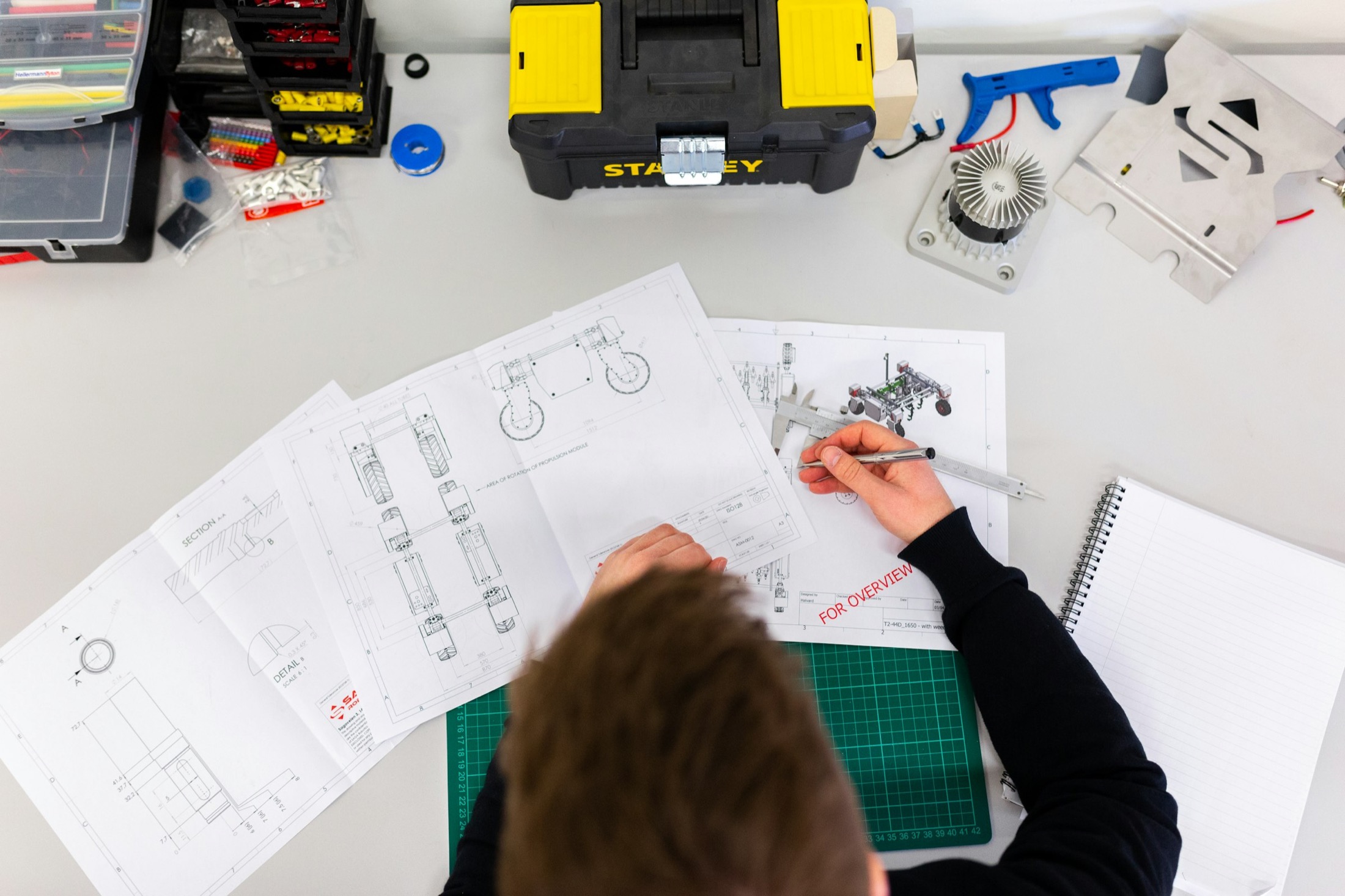
Rover blueprint work on a maker desk
Photo by ThisisEngineering on Unsplash

My Grand Challenge is to engineer the tools of scientific discovery under the Joy of Living theme. This portfolio traces how I have pursued that challenge across five mindsets, from outside-major coursework and CyberPatriot, through NASA L'SPACE systems engineering and Field Robotics Lab autonomy, to shipping KumonScan, mentoring with USC MESA, supporting Engineers Without Borders community projects, and tutoring and emergency-services work that put me on the receiving end of systems.

The path started before USC, at Civil Air Patrol's Aerospace Education STEM Academy at Edwards Air Force Base, when aviation stopped being a childhood interest and became something I wanted to pursue seriously. The sections that follow are the designation narratives for that arc: what I did, what I learned, and where I am taking each mindset next.

Multidisciplinary

Engineering solutions do not fail or succeed in a vacuum. They fail or succeed based on whether the people who depend on them can actually trust and use them, and that trust is shaped by the historical, social, and regulatory context a system is dropped into. I chose coursework outside my major specifically to sharpen that reading, because my Grand Challenge (engineer the tools of scientific discovery under Joy of Living) is useless if the claim a tool makes cannot survive the institutions and publics that have to accept it. In Drugs and Society, I studied how public health crises are shaped as much by policy design, stigma, and institutional trust as by the underlying science, examining how decades of shifting regulatory approaches to a single public health issue produced wildly different outcomes depending on the social framing applied to it at the time. In American History, I traced how technological and infrastructural shifts across the country's development were rarely adopted on technical merit alone, but through a slow negotiation between institutions, public opinion, and legislative precedent. WRIT-340, USC's advanced writing for business course, forced that skill into a graded deliverable. On the four-person team Talent Architects, I wrote every section of The Retention Advantage, our analytical report on voluntary employee turnover, except the introduction: executive summary, literature review, the comparative analysis of Costco, QuikTrip, Mercadona, and Sam's Club, empirical findings, organizational impact, and the conclusions and recommendations. The hard part was not finding statistics. Employers already say they care about retention, then misdiagnose exits as a pay problem while career stagnation, work–life strain, and management behavior dominate exit interviews. The end result is a finished report whose three recommendations (weekly manager coaching, published internal role ladders, jobs designed for work–life fit) each trace to a documented, preventable exit driver, structured so a skeptical manager would act rather than file another awareness brief.

Together, these courses gave me a vocabulary I now bring into technical work: a rover subsystem, a proposal budget line, or a cold-welding specification is never just an engineering artifact. It is also a claim being made to reviewers, institutions, and stakeholders who bring their own historical and social expectations to the table. When I later worked through interface and verification documents on a NASA mission concept team (detailed under Talent / Research), I found myself asking not only whether a requirement was satisfied, but why a program reviewer would trust the claim: the same question The Retention Advantage forced when a Costco tenure figure or an exit-interview category had to survive a reader who arrived expecting a different diagnosis. That transfer is the multidisciplinary result: humanities and business-writing training changed how I package technical evidence, not a second inventory of the same NASA artifacts.

Outside coursework, I competed on a Civil Air Patrol-sponsored squad in the AFA CyberPatriot National Youth Cyber Defense Competition, hardening Windows and Linux images by finding and removing unauthorized backdoor accounts and access points a red team had planted. The end result was not a lecture on security; it was images we could defend under timed scoring because the compromise was actually removed. I pursue that work under the same Grand Challenge, not a second one: a discovery tool only serves the people who depend on it if it is trustworthy and defensible, the same standard I hold aerospace and robotics systems to. Next, I will carry that security-first instinct into the medical and health technology work I plan to pursue after NASA, where a compromised device is a safety failure, not only a technical one.

Talent / Research

My path into this work started years before NASA, at Civil Air Patrol's Aerospace Education STEM Academy at Edwards Air Force Base, which first turned a childhood interest in aviation into something I wanted to pursue seriously. During my time at USC, I have built on that foundation through mentored research and systems engineering work aimed at building the tools of scientific discovery for extreme, unstructured environments, first in space, and now on the ground.

As Lead Systems Engineer on NASA's L'SPACE Team 19: Ad Astra, an 18-member Mission Concept Academy team working under Program Manager Alejandro Gonzalez and Chief Scientist Hannah Kim, my specific responsibility was the Command and Data Handling subsystem for our lunar permanently-shadowed-region volatile-prospecting rover: I authored the requirements narrative, software architecture flowchart, and verification matrix governing science data acquisition and S-band downlink, and coordinated with our thermal and communications leads to keep those interfaces consistent through Preliminary Design Review. Our team also relied on me to maintain the interface architecture for the entire vehicle, a 19-pathway ICD matrix and N² diagram linking payload instruments to every subsystem, and I co-led our thermal trade study governing survivability across a 40–394 K operating envelope.

The previous year, on NASA's L'SPACE Team 10: Forged in Orbit, our 12-member team, led by PI Joel Bhattarai and PM Alexis Gallardo, integrated science, engineering, and programmatic work into a $10,000-class technology proposal for autonomous cold-welding repair in vacuum; my specific contribution was deriving quantitative performance requirements (100 MPa minimum contact pressure, 10 kN actuation force, 80 MPa target shear strength) from ISS heritage data and materials-compatibility literature, and lead-authoring, alongside teammate Vasquez, a multi-agent lunar pathfinding framework we validated in ROS2/Gazebo simulation. The clearest lesson from this work, though, did not come from building a subsystem. It came from evaluating someone else's. Serving as a formal reviewer on NASA Review Panel #6, scoring competing technology proposals from Teams 16 through 18, I realized that what I was actually scoring was never technical elegance in isolation; it was whether a team understood who was depending on their mission succeeding, the scientists on Earth waiting on volatile-detection data, the future ISRU missions that would inherit an unproven cold-weld specification. That reframing changed how I read my own CDH verification matrix afterward: it stopped looking like a compliance document and started looking like a promise to the people who would eventually have to trust the data it produced.

This research thread continues in my current work with USC's Field Robotics Lab, where I work alongside a 10-person team building the full autonomy stack (sensor fusion, GNSS navigation, visual servoing, and safety interlocks) for our University Rover Challenge entry; my role has been leading the software side of that stack, translating the systems-engineering discipline I learned at NASA into a physical robot that has to work outdoors, not just on paper. Across both NASA programs, the lesson has been consistent: a scientific objective is worthless until it has been translated into a verifiable, falsifiable engineering requirement that someone else on the team can actually rely on, and learning to make that translation under review from real program managers, chief scientists, and now as a reviewer myself, has been the most formative research training of my undergraduate career. Next, I am taking that same requirement discipline into URC field testing, where the autonomy stack has to survive outdoor conditions instead of review slides, and using what breaks outdoors to harden the verification story before the next design cycle.

Viable Business / Entrepreneurship

My understanding of viable business models did not come from a classroom case study. It came from noticing a real operational inefficiency and shipping a working product to fix it. I chose this work in relation to my Grand Challenge because tools of scientific discovery only improve lives if the people who run them every day can trust them without calling an engineer: KumonScan was my first full cycle of discovering an operator problem, shipping under lean constraints, and measuring whether staff were actually better off. At the Kumon learning center where I worked, attendance was tracked with paper sign-in sheets, which made it nearly impossible for staff to notice attendance patterns worth flagging or to spend their time on anything other than manual record-keeping. I designed and built KumonScan, a full-stack web application that replaced those sheets with per-student QR codes for kiosk check-in and check-out.

QR alone still left the front desk walking the floor. The product only became operator-viable when I added a Desk roster where staff search by name, select Math, Reading, or Both, and see live elapsed time against a thirty-minute single-subject or sixty-minute both-subject allowance, with overtime rows turning red and showing overage minutes. Admin stores each student's enrolled subjects and scheduled weekdays so Desk can generate an absence list for students expected that day who never checked in, and the dashboard exports monthly or rolling twelve-month attendance as CSV (visits, total minutes, overtime count) alongside thirty-day charts and a three-or-more visits in seven days regulars flag. Registration stays capped at ten requests per minute; session timestamps still come only from timeapi.io. Shipping that taught me that viable products are defined less by technical sophistication and more by whether they reduce a specific, recurring cost for the person who has to use them every day. Next, I will apply that same operator-viability test to the robotics and medical tooling I build after NASA: if the person at the console is not better off, the discovery tool is not finished.

Multicultural / Global Dimension

As a Research Fellow with USC MESA for the last two years, I have mentored cohorts of underrepresented undergraduates working toward research readiness. This mindset is about cultural and institutional pathways, not one-on-one tutoring service (that belongs under Social Consciousness): the same university research door looks different depending on who is walking toward it, and which informal rules they were never taught. I chose MESA in relation to my Grand Challenge because tools of scientific discovery will keep being built by a narrow slice of students unless more people can reach the labs that make those tools. I developed and led workshops on scientific communication, literature review, and research proposal writing, and had to unlearn assumptions about what students already know how to do: how to cold-email a professor, how to read a rejection as normal rather than personal, how to interpret an ambiguous lab posting.

Facilitating peer mentorship cohorts meant sitting with students whose barriers were not ability but missing exposure to folklore better-resourced students absorb without noticing. Tracking progress toward research placement and graduate applications, and contributing to program assessment on mentee placement rates, gave me an outcomes view of representation gaps I had previously only understood anecdotally. The end result of that fellow work is a repeatable workshop and cohort practice I can hand to the next fellow, plus a habit I now bring into engineering teams: ask who is missing from a design process before calling a solution complete.

That same question travels off campus. As a member of the USC chapter of Engineers Without Borders (EWB-USA), I support international community engineering projects focused on sustainable water, sanitation, and infrastructure solutions. MESA taught me how gatekeeping works inside a U.S. research university; EWB asks how a water or sanitation system lands when the community that has to live with it is not the one that drew the CAD model. I pursue that under my Grand Challenge because Joy of Living discovery tools fail the same way abroad as they do in a lab: if the people who depend on them cannot operate, maintain, and trust the system, the engineering was incomplete. Next, I will keep mentoring through MESA and stay active in EWB chapter work while I am at USC, treating community partner constraints as design requirements rather than after-the-fact outreach, and treating staffing and authorship decisions on research and competition teams as part of the discovery pipeline, not an afterthought once the technical work is done.

Social Consciousness

At the center of every system I have worked on, from a lunar rover to a tutoring center's attendance sheet, are people whose needs the system is supposed to serve. My clearest lessons in social consciousness have come from working directly with people on the receiving end of a system rather than designing for them in the abstract. I pursue that under my Grand Challenge because Joy of Living discovery tools are used by operators, patients, and communities under real stress; if I do not understand what service requires of me, the tool will fail the people it claims to help. As a Kumon tutoring assistant, I worked one-on-one with elementary and middle-school students who were already behind classroom pace, a role I understood from both sides because I had been a Kumon student myself from age three. That history changed how I taught: I adjusted explanations in real time to a specific child's confidence and frustration rather than a generic lesson plan.

In parallel, six years in Civil Air Patrol, ending at Second Lieutenant after completing the full cadet leadership curriculum and ground-team qualification, immersed me in emergency services and search-and-rescue training built for a community's worst hours. The end results are concrete: a leadership rank earned through the cadet pipeline, ground-team qualification for field response, and a drilled habit of subordinating preference to a mission that exists to serve people I may never meet. Between tutoring a struggling student and training for community-wide emergency response, social consciousness became a default posture: before I call a system successful, I ask who it was built to serve and whether I actually understand what that service requires. Next, I will carry that ask into operator-facing autonomy work at Field Robotics Lab and into the medical and health technology path I am building toward after NASA, where the person depending on the tool is not optional context.

Anything else you may want the committee to know

Before I could explain what an engineer was, I already wanted to be one. As a child, my family gave me toy helicopters and airplanes, and I would take them apart just to see how the pieces fit together, an instinct my parents redirected into Kumon, which I started at age three and stayed with long enough to become one of the program's top-ranked students in North America for my age group, later moving into accelerated coursework through Johns Hopkins' Center for Talented Youth. My parents taught me early that a commitment, once made, has to be fulfilled regardless of how the day is going, and that lesson turned a once-a-day worksheet habit into a discipline I still rely on. Even then, my interests never really changed: I wanted to build and fix machines, and I wanted, someday, to help people. My mother once pointed out that whether it showed up as an interest in aviation, robotics, or medicine, my dreams stayed the same even as the vocabulary around them grew more sophisticated. That continuity is not something I discovered later; it is the thing I have been building toward the whole time, from taking apart toy helicopters to now authoring interface specifications for a lunar rover.

That underlying commitment was tested in a different way during a mock search-and-rescue exercise in Civil Air Patrol. My ground team was given a simulated missing-person scenario at two in the morning: a "lost hiker" played by a fellow cadet, radio contact intermittent, temperature dropping, and a stack of procedures we had drilled dozens of times suddenly feeling very different once they had to be applied under real fatigue and real cold. What struck me afterward was not how the procedures performed, but how differently I understood them once I had felt, even in simulation, what it was like to be the person those procedures existed for. A checklist that had felt like paperwork in a classroom became, at two in the morning, the only thing standing between confusion and a plan. My engineering education has given me an increasingly sophisticated vocabulary for describing systems (subsystems, interfaces, KPPs, requirements), but between a childhood spent taking machines apart to understand them and a night spent depending on a checklist meant for someone else, I have the reason I care about getting them right. I want my career to be spent building things precise enough to be trusted by the people who have no choice but to depend on them, and I see the Grand Challenges Scholars Program as the structure that will keep me honest about that goal as my technical work grows more ambitious.